‘Math Is for Everybody’: DPK Strengthens Support for Building Foundational Math Skills in Young Learners
January 27, 2026
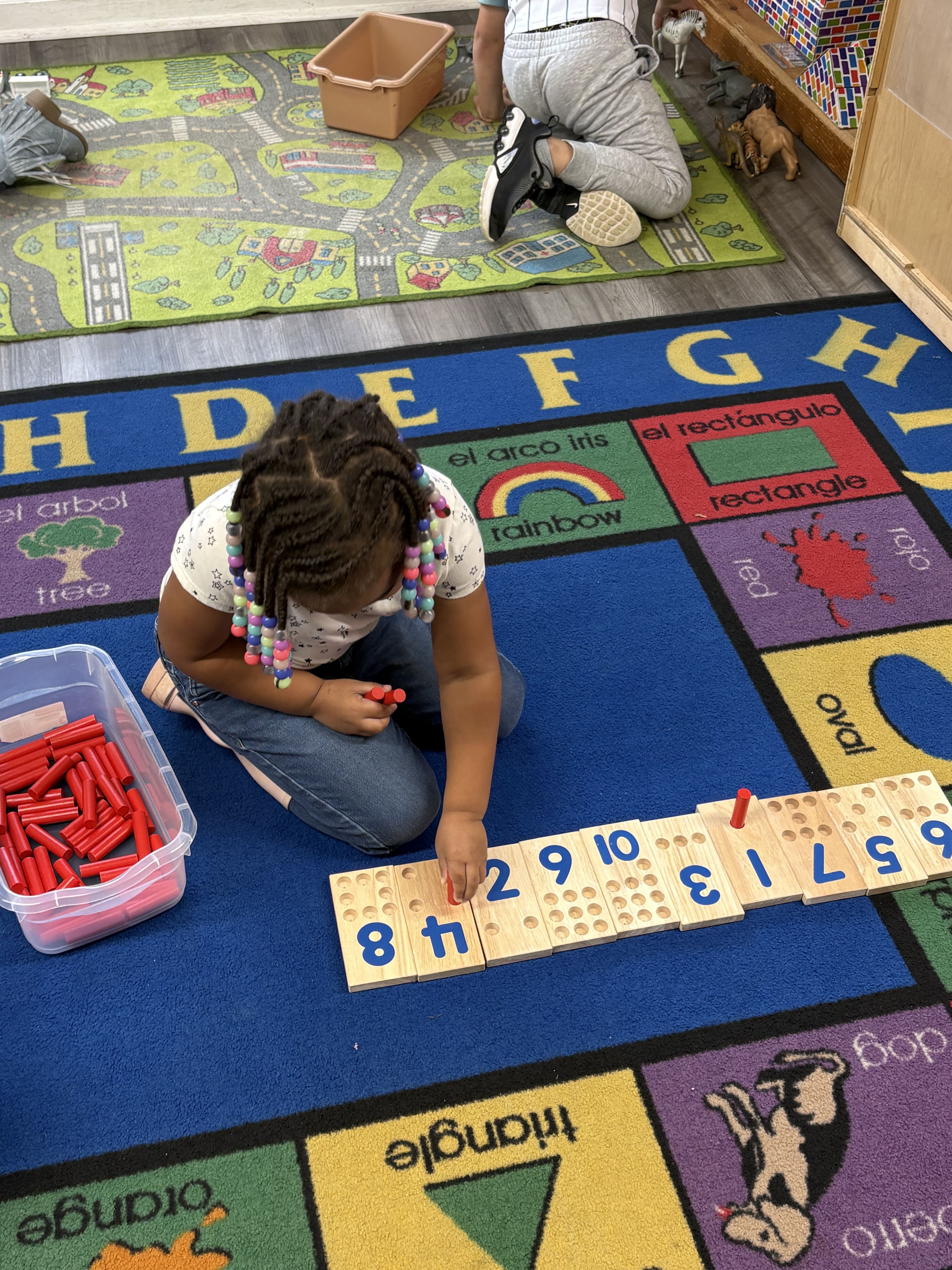
A hallmark tenet of early childhood education over the last couple of decades is that children can learn much more and at considerably younger ages than previously thought.
This rings true in virtually all subject areas - even math! Preschoolers have a great capacity for understanding and applying math concepts, and solid math skills can also boost learning capacity across the board. That is why DPK is significantly increasing support for teachers to build stronger foundational math skills among young learners.
“The research shows that in PreK classrooms where math is a strong focus, students’ academic skills are higher in other areas, including social, emotional, and behavior management,” said Nita McAdoo, Instructional Support Manager for Early Years. “All cognitive skills are enhanced when children are being introduced to math concepts early. If we build those foundational skills early, then we can see greater success when they move on to kindergarten.”
Supporting teachers in math instruction
Teaching math doesn’t necessarily come easily to every educator who didn’t study mathematics education. Realizing this, McAdoo and her Early Years colleagues actively support Durham PreK teachers in math instruction through coaching, modeling, regular meetings, and additional professional development support.
“We go into the classroom and model for the teachers ways to improve, increase, and strengthen math in their classrooms,” said McAdoo, adding that many teachers receive bi-weekly visits from her team. “We don’t want to take over. But we do observe teachers in the classroom and then make suggestions.”
Such suggestions might include encouraging teachers to incorporate math into as many activities as possible. Preschool classrooms feature learning “centers” through which students rotate during the course of the school day. The centers’ themes include Blocks, Music, Literacy, Reading, Dramatic Play, Science, and of course - Math.
Opportunities abound during the course of a given school day for students to learn sorting, patterning, spatial relationships, and problem solving. McAdoo and her team encourage teachers to weave math-related learning throughout as many of the centers’ activities as possible.
One example of this might be giving students rulers to measure the structures they have put together with building blocks. Another could be to have students learn how to set timers that will indicate when it’s time to rotate to the next center.
Instructional support team members also hold regular monthly Professional Learning Communities (PLC) meetings with teachers to exchange ideas and strategies.
“When we’re meeting with the teachers, we are discussing with them how to do hands-on exploration and how to use more ‘math talk,’” said McAdoo. “That helps build their vocabulary and also improves their math comprehension.”
Aligning math instruction with proven curriculum
DPK has enjoyed a great deal of success with students meeting and exceeding achievement goals with the Teaching Strategies Gold® (TSG) curriculum. Math concepts that DPK instructional support professionals introduce align with TSG and are showing positive results.
This includes monthly “math themes” around which teachers may build their lesson plans. All DPK teachers can access these “Math Blast” folders with the monthly themes and ideas for incorporating them into their lessons.
For a glimpse at the kinds of activities teachers might find in their Math Blast folders, take a look below at some examples of student activities for the January 2026 theme of “Patterns” as they rotate through their classroom centers:
- Transitions: Create different Pattern Paper Chains. Cut strips of colored paper. As you dismiss children from group time, have them add the next color to the pattern. They can choose the color and push the stapler to add each link.
- Literacy: After reading the story, “The Very Hungry Caterpillar,” create caterpillar pattern necklaces with straw pieces and construction paper circles.
- Dramatic Play: Play the game, “Is This A Pattern?” Pull articles of clothing and toys that have patterns on them and some that don’t. Place them all in a bag. Pull them out one at a time and ask, “Is this a pattern?” Make sure to READ each pattern with the children to practice that skill. For example, “Red-White-Red-White-Red-White.” It’s important to have some items that are NOT patterns so that children are learning to distinguish between the two.
- Blocks: Create pattern templates for those children that are still learning the concept of patterning. Set them up for success by offering these prompts. Sit with them and talk through what they are doing as they create the pattern before them. For example, you just put down a triangle. What shape goes next? You picked a square! Now a triangle… Next a square. You are making a pattern! Let’s read the whole thing together. Point to the pieces as you read the pattern.
- Table Top: Place popsicle sticks of various colors at the table and encourage kids to create their own patterns. Stay close by and make sure you READ the patterns with them as they work. Scaffold their learning by noticing errors and prompting them in a fun way to make corrections. Create your own, more complex patterns, as they watch. Encourage them to create the same pattern in their workspace.
- Playground: Go on a “Pattern Hunt" around the school. Take photos of different patterns you see in the environment. Print your pictures and create a book or bulletin board from the patterns you found on your walk.
- Crafts: Create Pattern Worms using simple colored scraps of paper. Scaffold learning by encouraging kids to create patterns from shapes or colors.
The ‘magic’ of math
“We want to reassure parents and families that math is for everybody,” said Dr. Frédérique Yova, Senior Research Manager at Early Years. “It’s really about seeing math all around you - wherever you are, whatever the kids are doing.”
Dr. Yova is leading the “Math Magic: It’s More Than Just Counting” session for the Early Years annual ASK (Advancing Skills and Knowledge) Conference in late February 2026.
“I really believe in learning by doing, so I will introduce different areas of math in my session. We want early childhood educators to realize how much they already do and already know regarding math in all aspects,” said Dr. Yova.
“It’s mostly about connecting the pieces of what they are already doing and being more aware of what they are doing, because once you are aware you can focus more on the children's thinking and how to extend their thinking,” she added. “Instead of providing the answers, it’s more about brainstorming with the students, and how we can figure it out together.”
Dr. Yova holds a Ph.D. in elementary education with a focus on early mathematics from North Carolina State University. She wants DPK students, teachers, and families to know that math is integral to everyday life. Math should be embraced by everyone, and not something to be feared.
“When you look a little deeper you realize that we do math all the time,” said Dr. Yova. “Too many people associate math with a bad school experience. We want to help people get rid of those bad feelings and fall in love with math again - or for the first time.”
Supporting families in encouraging pre-schoolers to grasp math concepts
Both McAdoo and Dr. Yova hope that families with pre-school students will embrace their role in reinforcing the importance of having foundational mathematics skills at home.
“What happens in the classroom and what happens in the home can be equally important for students,” said Dr. Yova. “Once you can see all the math in the classroom, you can also encourage families to see the math in their homes, and bring that perspective to light for their children.”
Family engagement is key to student success in math and all academic areas, said McAdoo. DPK continues to seek methods in which teachers and administrators can reach out to families to support reinforcement of math skills at home.
“We are encouraging the teachers to share activities with parents and families,” said McAdoo, who added that the TSG portal includes a tab for families that provides activities they can easily employ at home to underscore what students are learning at school.
“We’re asking teachers to drop activities that they can do at home in that folder for parents,” said McAdoo. “They are really easy things that can be done at home.”