Durham PreK Students Strike ‘GOLD®’ in Meeting or Exceeding Academic and Developmental Expectations
March 18, 2026
How can families be assured that their preschool children are learning and developing critical skills at the levels that will ensure a seamless and successful entry into their K-12 journey?
The Early Years Durham PreK program has found one way to demonstrate this, and the results are pretty remarkable. An assessment of students’ academic progress along with social, emotional, and physical development for the 2024-25 school year found significant growth within all areas.
According to the assessment report, “2024-25: A Study of Durham Pre-K Growth,” more than nine in 10 preschool children assessed were achieving at or above expectations in five of six academic or developmental areas, or “domains”.
Dr. Linda Chappel, Senior Vice President for Triangle Area Child Care Resource and Referral at Early Years, said the Durham PreK team is very pleased with the study’s results, but is quick to underscore the importance of how the findings can inform continuous improvement for children.
“This is how a teacher learns about their children’s progress, how they develop lesson plans, and how they will create a strong environment for children,” said Dr. Chappel of the assessments, adding that this study should not be misconstrued as standardized testing.
“We’re not testing 4-year-olds, but by using this assessment tool, we are seeing how our children are making progress in their journey to kindergarten,” she said. “We’re really looking closely at how our children are growing through the school year and making adjustments to improve their experiences.”
Dr. Chappel added that this report honors Durham PreK’s commitment to investing in children’s growth and highlights the Durham community’s commitment to expanding access to high quality preschool programs across the county.
“This helps us review our strategies so that the program and the children can have the best experiences,” she said. “This review is also a resource that gives the community confidence in the quality of our preschool programs. We need to honor the financial investments in the program by being accountable.”
Methodology and Findings
Durham PreK employs Creative Curriculum®, a developmentally appropriate and research based curriculum used in all classrooms. The SmartTeach GOLD® Assessment tool (a component of Teaching Strategies GOLD®, or TSG) measures the developmental progress of children from birth through third grade. Educators use this tool to monitor preschool students’ progress, support individualized learning, and communicate results with families.
The assessment is based on documentation from teachers regarding children’s progress through notes, photos, and work samples. Data were taken from all Durham PreK children in publicly funded seats (including NC Pre-K, Durham PreK, Title I, or a combination of these since the program follows a braided funding model). Students were assessed in fall 2024 and again in spring 2025.
Six “domains” were measured: social-emotional, physical, language, cognitive, literacy and mathematics. Results were categorized as numbers of students achieving below GOLD ®’s expectations for pre-school students, or as numbers of students meeting or exceeding those expectations.
Dr. Frederique Yova is Senior Research Manager with Early Years. She and the Durham PreK team compiled the study from the assessments taken at the program level.
“As a researcher I was delighted to run the data analysis,” said Dr. Yova. “I was able to ask questions to the team any time I needed; the TSG assessment is very detailed.”
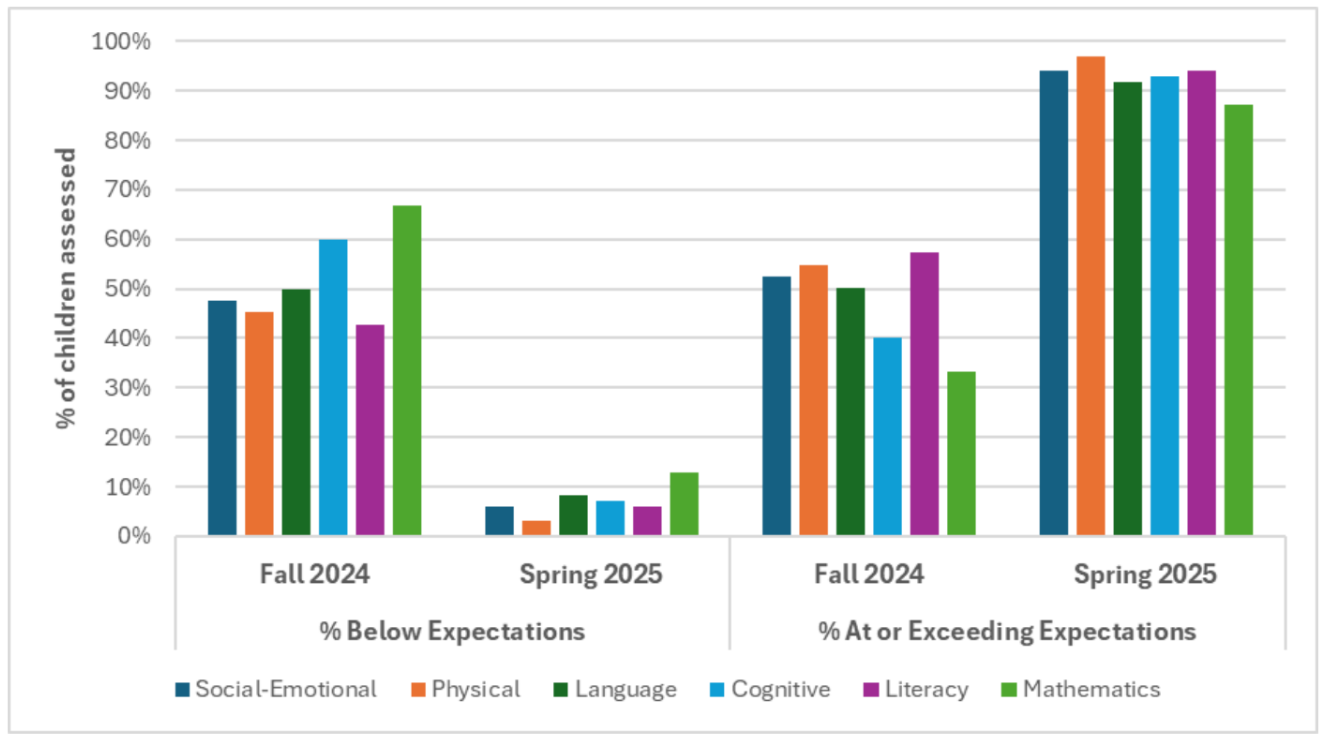
Growth findings of the six domains with brief explanations of each are as follows (with an accompanying chart [or charts] below):
Social-emotional domain: A child’s ability to manage emotions and build relationships. Empathy, communication, collaboration, sharing, and self-regulation all figure into this assessment. Of 744 children assessed in fall 2024, 349 (48 percent) were identified as being below expectations in this area. In the spring 2025 assessment, that number had plummeted to 43 (6 percent), with a total of 691 children, or 94 percent at or above expectations at the end of the year.
Physical domain: Includes “gross motor skills” (running, jumping, climbing) and fine motor skills (holding a pencil, using scissors, buttoning clothing), all essential for developing physically. In fall 2024, 336 of 742 children assessed (45 percent) were below expectations. That number fell to 23 (3 percent) in spring 2025, for a total of 719 children, or 97 percent, at or above expectations.
Language domain: Communication skills such as speaking, listening, vocabulary, and grammar. Also expressing needs, asking questions, and successfully sustaining conversations. Of 740 children assessed, 368 (50 percent) were below expectations in fall 2024. That number was down to 62 (8 percent), with 678 children, or 92 percent, at or above expectations the following spring.
Cognitive domain: Thinking skills, problem-solving skills, memory skills, and understanding concepts are important in applying knowledge in a variety of situations. In fall 2024, 446 of 744 children assessed (60 percent) were below expectations. This number plunged to 52 (7 percent) in spring 2025, making 692 children, or 93 percent, at or above expectations.
Literacy domain: Recognizing letters, the sounds they make, and beginning to learn how to read and write. These skills are developed through storytelling and working with words. The fall 2024 assessment revealed that 316 of 740 children assessed (43 percent) were below expectations in the literacy domain. By spring 2025, only 44 children (6 percent) were found to be below expectations, with 696 children, or 94 percent, at or above grade level.
Mathematics domain: Counting, measuring, recognizing shapes and patterns, along with basic addition and subtraction. These skills are crucial in the development of problem-solving and logical thinking. Of 741 children assessed in fall 2024, 494 (67 percent) were found to be below expectations in the mathematics domain. That number had fallen to 96 (13 percent) below expectations, for a total of 645 children, or 87 percent, at or above expectations in the spring 2025 assessment.
While showing significant improvement, mathematics was the only domain to fall slightly short of 90 percent at or above expectations. Dr. Chappel said there will be a concerted effort around supporting educators in this area through bolstered professional development around using storytelling to apply to mathematical concepts.
Data Inform Improving Support for Early Educators
Maggie Connolly is the Durham PreK Instructional Support Quality Enhancement Manager. A key role for her is to ensure that early educators in Durham are getting the support and professional development they need to create the best possible learning experiences for their students.
Connolly says that the TSG curriculum and assessment tools employed have contributed greatly to helping teachers get better at what they do. It will also inform the types of professional development and other types of support that she and her colleagues will provide to educators.
“The teachers’ knowledge of the SmartTeach system and how to work with that has brought us along further and faster. It’s made the job easier for teachers to capture the data and assign the data to objectives to assess,” said Connolly. “Technical support from the quality enhancement coaches has helped in supporting teachers in their goal of doing quality ongoing authentic assessments of young children’s development in all domains.”
Chappel and Connolly both point to the social-emotional domain as being key at this stage in a child’s development.
“One of the most important areas is the social-emotional domain,” said Dr. Chappel. “Particularly coming out of COVID, our society was so impacted by the isolation during that time, and it can be argued that the most affected were young children.”
“Coming into school, coming out of COVID, you could expect that there would be a need for extra support for children. Social-emotional support is what’s going to help a child in the long run to navigate the work, to really be successful.”
Connolly added that early educators are increasingly able to prepare preschool children for the social-emotional skills they will need to start kindergarten on day one.
“It’s a kindergarten teacher’s dream, for students to be able to come into the classroom, put away their own things, ask good questions, and be able to talk with their friends,” said Connolly. “Everything else comes after a child feels safe and nurtured, and willing to take risks because they feel comfortable with themselves.”